There is a moment every Private Limited Company director in Pune eventually faces.
An email arrives — or worse, a notice — from the Ministry of Corporate Affairs. Penalties have been levied. Filings are overdue. The late fee has been compounding, quietly, for months. And the director who received the notice had absolutely no idea any of this was due.
This is not an uncommon situation. It is, in fact, one of the most frequent problems we deal with at Akhil Amit And Associates. Not because founders are careless, but because nobody sat them down at the time of incorporation and explained what the Companies Act, 2013 actually requires from a Private Limited Company — every single year, regardless of revenue, regardless of whether the company has done any business at all.
This guide does that.
If you have a Private Limited Company registered in Pune or Pimpri Chinchwad — whether you incorporated last year or five years ago — this is your complete annual compliance reference. Read it once, share it with your co-founders, and use it every year.
Why Annual Compliance Cannot Be Ignored
Before getting into the specifics, it is worth understanding the legal framework.
Under the Companies Act, 2013, a Private Limited Company is a separate legal entity with its own obligations. These obligations exist from the moment the company is incorporated and continue every year — whether the company has revenue, employees, bank transactions, or not.
A dormant company with zero transactions still has mandatory annual filings. A newly incorporated company that has not yet started operations still has a compliance deadline within 30 days of incorporation. There is no grace period for new companies and no exemption for inactive ones.
The penalty structure under the Companies Act was significantly tightened in recent years. Most defaults now carry a fixed penalty plus a daily continuing penalty for every day the default continues. On some forms, the daily penalty for officer-in-default runs at ₹500 to ₹1,000 per day. For a company that discovers a three-year-old default, the penalties alone — before any legal fees — can run into several lakhs.
This is the cost of not knowing your compliance calendar.
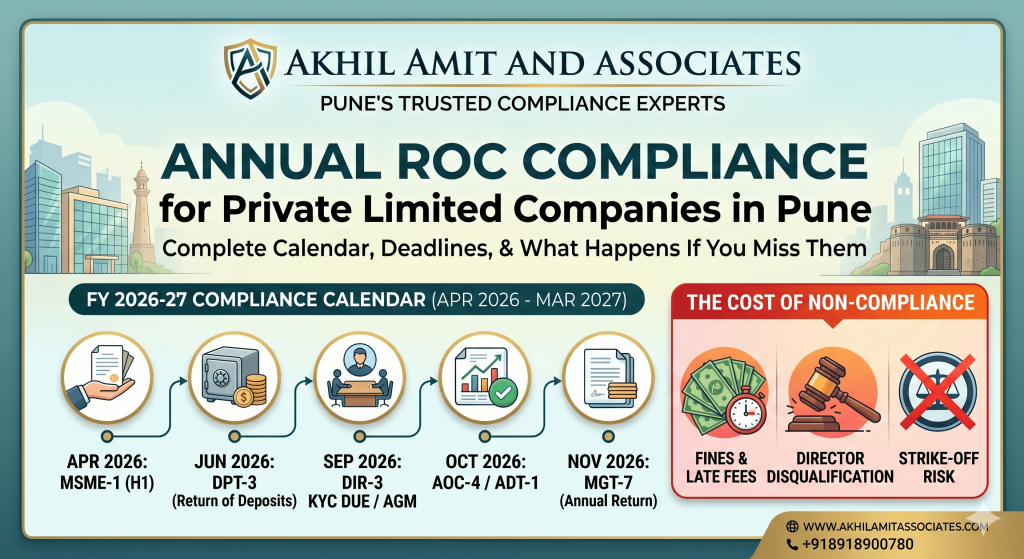
The Complete Annual Compliance Calendar for Private Limited Companies
INC-20A — Commencement of Business Declaration
Due: Within 180 days of the date of incorporation Who it applies to: Every Private Limited Company incorporated after November 2, 2019 What it is: A declaration by the directors that every subscriber to the Memorandum has paid the value of shares agreed to be taken by them. In plain terms, it confirms that the subscribed share capital has been deposited in the company’s bank account. Why it matters: This is one of the most commonly missed compliance items for newly incorporated companies. A company that has not filed INC-20A technically cannot commence business — and cannot borrow money, invest, or deploy capital. Penalty for non-filing: ₹50,000 on the company and ₹1,000 per day on every officer in default for the period during which the default continues.
Practical note for Pune founders: INC-20A requires the company’s bank account to already be active and the share capital to have been deposited. This is why opening the current account immediately after incorporation — not weeks later — is important. The 180-day window sounds generous until you factor in bank account opening delays.
ADT-1 — Appointment of First Auditor
Due: Within 30 days of incorporation (Board appointment) — ADT-1 filing within 15 days of AGM thereafter What it is: Every Private Limited Company must appoint a statutory auditor — a practicing Chartered Accountant — within 30 days of incorporation. This appointment is made by the Board of Directors and notified to the ROC through Form ADT-1. The first auditor: Appointed by the Board within 30 days of incorporation to hold office until the conclusion of the first Annual General Meeting. Subsequent auditors are appointed at the AGM for a term of five years. Penalty for non-filing: ₹25,000 minimum, extendable up to ₹5,00,000.
Practical note: This is the most commonly missed 30-day deadline for new companies. Founders who incorporate and then take a few weeks to focus on the business often miss this window without realising. It should be part of your Day 1 post-incorporation checklist.
DIR-3 KYC — Director KYC
Due: September 30 every year Who it applies to: Every individual who has been allotted a Director Identification Number (DIN), regardless of whether they are currently an active director. What it is: An annual KYC declaration by directors, confirming their personal details including PAN, Aadhaar, mobile number, and email address. Directors file DIR-3 KYC through the MCA portal using their own credentials. Penalty: If DIR-3 KYC is not filed by September 30, the DIN is deactivated. A deactivated DIN means the director cannot sign any board resolution, file any ROC form, or perform any director-related action until the KYC is completed with a ₹5,000 late fee.
Why this matters practically: If a director’s DIN is deactivated and they need to sign off on a bank transaction, a property agreement, or a government tender — the company is stuck until the KYC is completed and the DIN reactivated. This is a situation that is entirely preventable with a calendar reminder.
Pune-specific note: We send all our clients a DIR-3 KYC reminder in August — well before the September 30 deadline — to ensure no director’s DIN is accidentally deactivated. If you are not receiving compliance reminders from your CA, this is a gap worth addressing.
AOC-4 — Filing of Financial Statements
Due: Within 30 days of the Annual General Meeting (AGM). For most companies with a March 31 financial year end, this falls around October 29 to November 29. What it is: The annual filing of your company’s financial statements with the Registrar of Companies — balance sheet, profit and loss account, director’s report, auditor’s report, and related schedules. These documents are prepared by your statutory auditor after the audit is complete. Late fee: ₹100 per day of delay. For a filing that is 30 days late, this is ₹3,000. For 90 days late, ₹9,000. For a company that misses an entire year and files two years later — the numbers compound quickly.
Practical note on timing: AOC-4 cannot be filed until the statutory audit is complete and the financial statements are signed by the auditor and the board. This means the audit must be completed before the AGM, which must be held before October 29 (for March 31 year-end companies). Founders who delay getting their accounts in order until October frequently end up with rushed audits, which increases the risk of errors and missed deductions.
MGT-7 / MGT-7A — Annual Return
Due: Within 60 days of the AGM. For March 31 year-end companies, this typically falls around November 28 to November 29. What it is: The company’s annual return to the ROC containing details of the company’s share capital, directors, shareholders, registered office address, and changes during the year. MGT-7 is for companies with turnover above ₹2 crore or paid-up capital above ₹10 lakh. MGT-7A (a simplified form) applies to smaller companies. Late fee: ₹100 per day of delay, same as AOC-4.
Important note: MGT-7 must be certified by a practicing Company Secretary for companies that are not small companies. This is a detail that catches some founders off guard when they are filing for the first time and discover they need a CS sign-off in addition to their CA.
MBP-1 — Disclosure of Interest by Directors
Due: At the first Board Meeting of every financial year (typically April) What it is: Every director must disclose their interest in other companies, firms, bodies corporate, or individuals at the first board meeting of each financial year. This disclosure is recorded in the minutes and maintained in the company’s statutory registers. Why it matters: While MBP-1 is not filed with the ROC, it is a mandatory board compliance item. Missing it is a technical default under the Companies Act that can become relevant during due diligence or disputes.
Form 8 MSME — Payment to MSME Vendors
Due: October 31 and April 30 (half-yearly) Who it applies to: Companies with turnover above ₹250 crore OR companies that have received advances from MSMEs exceeding 45 days. What it is: A half-yearly return declaring payments due to MSME vendors that are outstanding beyond 45 days. Note: Many companies that interact with MSME vendors and do not track the 45-day payment window are technically in default on this filing. It is worth auditing your vendor payment cycles.
The Annual General Meeting — What It Actually Requires
The AGM is not just a calendar event. Under the Companies Act, it is a mandatory annual gathering of the shareholders of the company with specific procedural requirements.
When it must be held: Within 6 months from the end of the financial year — i.e., by September 30 for companies with a March 31 year-end. The first AGM must be held within 9 months of the end of the first financial year.
What must happen at the AGM:
- 1. Financial statements for the year must be presented and adopted
- 2. Dividend, if any, must be declared
- 3. Directors retiring by rotation must be re-appointed (or replaced)
- 4. Auditor must be appointed or re-appointed
- 5. Director’s report and auditor’s report must be read
What must be documented: Every AGM requires a notice to shareholders (minimum 21 days before the meeting), a quorum (minimum 2 members personally present for a Private Limited Company), and minutes of the meeting prepared and signed within 30 days.
For many small Private Limited Companies in Pune with the same individuals as directors and shareholders, the AGM is treated as a formality. It still needs to be properly documented. Undocumented AGMs are a technical default that shows up in due diligence and investor audits.
Annual Compliance Summary — Dates at a Glance
| Filing | Due Date | Penalty for Delay |
|---|---|---|
| INC-20A | Within 180 days of incorporation | ₹50,000 + ₹1,000/day |
| ADT-1 (First Auditor) | Within 30 days of incorporation | ₹25,000 minimum |
| DIR-3 KYC | September 30 every year | ₹5,000 + DIN deactivation |
| AGM | September 30 (March year-end) | ₹1,00,000 minimum |
| AOC-4 | 30 days after AGM | ₹100/day |
| MGT-7 / MGT-7A | 60 days after AGM | ₹100/day |
| MBP-1 | First Board Meeting of FY | No ROC filing but board default |
| Form 8 MSME | October 31 and April 30 | ₹100/day |
Beyond ROC — Other Annual Compliance for Private Limited Companies in Pune
ROC filings are the most widely discussed compliance, but a fully compliant Private Limited Company in Pune also has obligations under the Income Tax Act, GST law, and Maharashtra state law that run in parallel.
Income Tax:
- 1. Advance Tax payments: June 15, September 15, December 15, March 15
- 2. Tax Audit under Section 44AB (if turnover exceeds ₹1 crore): Report due by September 30
- 3. Income Tax Return (ITR-6 for companies): Due October 31 (or November 30 if transfer pricing applies)
TDS Compliance:
- 1. Monthly TDS deduction and payment by the 7th of the following month
- 2. Quarterly TDS returns: Form 24Q (salary), Form 26Q (non-salary)
- 3. Quarterly TDS certificates to vendors and employees
GST Compliance:
- 1. Monthly or quarterly GSTR-1 and GSTR-3B depending on turnover
- 2. Annual GST return (GSTR-9) by December 31
- 3. GST Audit (GSTR-9C) for turnover above ₹5 crore
Profession Tax (Maharashtra):
- 1. PTRC: Monthly or annual payment depending on liability
- 2. PTEC: Annual payment of ₹2,500
Running all of these in parallel — ROC, income tax, TDS, GST, and profession tax — is what full compliance management for a Private Limited Company actually looks like.
How We Manage Compliance for 250+ Companies in Pune
At Akhil Amit And Associates, we act as the compliance backbone for over 250 Private Limited Companies and LLPs across Pune and Pimpri Chinchwad.
Every client receives a compliance calendar at the time of incorporation or engagement. We track deadlines internally and send reminders well in advance — not the day before a due date. Our clients do not discover missed filings from MCA notices. They hear from us first.
We handle statutory audit, AOC-4, MGT-7, DIR-3 KYC, INC-20A, ADT-1, TDS returns, GST filings, income tax, and profession tax — under one roof, for one fee. No hunting for different consultants for different filings. No gaps in coordination between your CA and your tax consultant.
If your company is currently managing these filings reactively — or if you are unsure whether your compliance is fully up to date — we are happy to conduct a compliance review and tell you exactly where you stand.
Frequently Asked Questions
What is the most commonly missed compliance for Private Limited Companies in Pune?
INC-20A for new companies and DIR-3 KYC for established ones. Both carry significant penalties and are entirely preventable with proper calendar management.
Can a Private Limited Company with zero transactions skip annual filings?
No. Zero-transaction companies still have mandatory ROC filings — AOC-4 and MGT-7 — every year. The financial statements will show nil activity, but they must still be prepared, audited, and filed.
What happens if my company has accumulated compliance defaults from previous years?
The MCA provides a condonation of delay scheme periodically (CFSS — Companies Fresh Start Scheme) that allows companies to file overdue forms with reduced penalties. Outside of these schemes, late fees must be paid along with the filing. A compliance audit to identify all defaults is the first step before beginning remediation.
How much does annual ROC compliance cost for a Private Limited Company in Pune?
The cost depends on the company’s turnover, number of transactions, paid-up capital, and specific compliance requirements. We provide transparent, all-inclusive annual compliance packages covering audit, AOC-4, MGT-7, DIR-3 KYC, income tax return, and board meeting documentation. Contact us for a quote specific to your company.
Do I need a Company Secretary for MGT-7 filing?
Companies that are not classified as small companies (turnover above ₹2 crore or paid-up capital above ₹10 lakh) require MGT-7 to be certified by a practicing Company Secretary. For small companies, MGT-7A can be self-certified by a director.
Is statutory audit mandatory even if my company has no revenue?
Yes. Every Private Limited Company must appoint a statutory auditor (ADT-1) within 30 days of incorporation. The audit is mandatory every financial year regardless of revenue, and audited financial statements must be filed with the ROC through AOC-4.
Akhil Amit And Associates is a Chartered Accountant firm in Pune and Pimpri Chinchwad providing company registration, ROC compliance, statutory audit, GST, income tax, and FEMA advisory services to startups, MSMEs, and growing businesses.
Related articles on this website:
- 1. Private Limited Company Registration in Pune — Complete Process and Documents
- 2. Post-Incorporation Registrations: GST, Shop Act, Udyam, Profession Tax, Import Export Code in Pune
- 3. Why Akhil Amit And Associates Is Pune’s Most Trusted CA Firm for Private Limited Company Registration & Compliance.